In a nutshell
- 🧠 Objects act as context-rich cues that trigger habits quickly, making memory anchoring more effective than generic phone alerts.
- 🔬 The brain’s habit loop (cue–routine–reward) and the basal ganglia favour concrete, multisensory cues; visual, tactile, and auditory signals accelerate recall and action.
- 🏠 Real-world anchors—kettle + vitamins, trainers by the door, open notebook—reduce friction and prompt behaviour before conscious negotiation begins.
- 📱 Digital reminders often fail due to alert fatigue and context mismatch; objects “own” physical space, so they prompt action at the right moment.
- 🧭 Design an anchor system: choose a distinctive object, place it in the path of least resistance, refresh its salience, and pair it with routines; use visual, tactile, auditory, or olfactory anchors for reliable follow-through.
Every day, certain objects quietly choreograph our behaviour. A mug by the kettle cues tea. Trainers by the door whisper “run”. This is the magic of memory anchoring: the mind’s knack for welding a behaviour to a thing, in a place, at a time. It’s not mystical. It’s context. While phone alerts nag, physical items nudge. They do it gently, predictably, and often faster. Why? Because the brain relies on cues embedded in the environment to decide what to do next. Understand that, and you can hack your habits without brute willpower or another app notification.
The Neuroscience of Cues and Context
Inside your head, the basal ganglia assembles routine sequences into shorthand. Psychologists call this the habit loop: cue, routine, reward. Objects excel at being cues because they are concrete, persistent, and tied to a specific location. A water bottle on your desk becomes a visual trigger. A yoga mat rolled out beside the bed turns into a tactile invitation. Objects live where the behaviour happens, so they fire the loop before you consciously “decide”.
Memory is not a single storage locker. It’s state-dependent and context-bound. When your surroundings match the context in which you learned a behaviour, recall accelerates. Digital reminders often fire out of context. You get “Drink water!” on the Tube. Useful? Hardly. But the clink of a glass on your desk at 11 a.m.—that’s a cue riding on multisensory rails: sight, sound, touch. Multimodal cues beat abstract texts because they recruit more neural pathways, giving the routine a head start before attention drifts elsewhere.
There’s also the matter of friction. Objects reduce it. If the dumbbells are within arm’s reach, the micro-cost of starting shrinks. Fewer steps, stronger follow-through.
Objects as Anchors: From Kitchen Kettles to Gym Shoes
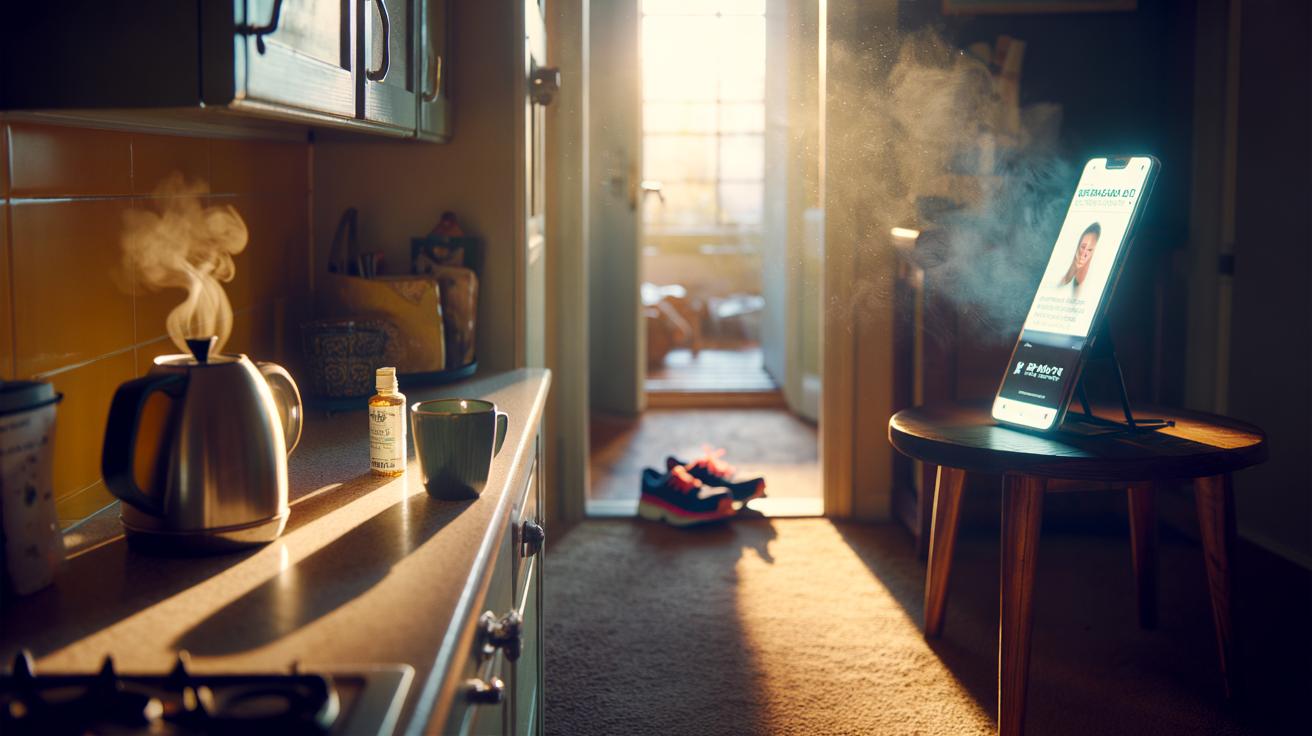
Consider the humble kettle. Place a vitamin tin next to it and mornings transform. As steam rises, you take the supplement. No calendar alert needed. Trainers by the front door do similar work. Their shape, their smell even, act as a behavioural nudge. When an object and an action are consistently paired, your brain learns to bind them. Over time, the cue alone elicits the urge.
In offices, a notebook opened on a clean desk announces “deep work”. A closed laptop on a shelf signals the end of the day. In kitchens, a chopping board left out after breakfast primes an evening salad, not takeaway. Small, tactical props outperform pep talks. They’re honest. They don’t promise; they prompt.
Design matters. Bright colours boost salience. Distinct textures help the cue cut through visual clutter. Put the most important object in the path of least resistance. Hide the competing one. Fruit bowl centre stage, biscuits top shelf, step stool missing. That’s not discipline; that’s architecture. Your space becomes policy—quiet, consistent, effective. The result is speed. You act before the negotiation starts, and momentum carries you the rest of the way.
Why Digital Reminders Often Fail
Reminders are disembodied. They arrive at arbitrary moments, detached from the environment where the action should happen. The phone pings while you’re on a call, in a queue, or mid-scroll. You swipe, snooze, forget. Without a physical cue to bridge intention and action, the prompt dissipates. It’s not that reminders are useless; they’re just weak on their own.
There’s also the adaptation problem. Alert fatigue sets in. The more notifications, the less you notice any of them. Meanwhile, the best anchors grow stronger with use. Objects don’t compete for attention in the same way; they occupy territory, not bandwidth. A foam roller at the end of the sofa doesn’t need a push notification. It just sits in your line of sight, every evening, after the commute, when the opportunity window is open.
Context mismatch adds delay. A reminder to plan meals at 3 p.m. rarely coincides with your fridge. But a whiteboard on the kitchen door? Instant capture of ideas as you pass. Speed matters because habit formation hinges on repetition with minimal friction. If a cue is actionable at the exact moment you perceive it, the behaviour crystallises faster.
Designing Your Personal Anchor System
Start with one routine you genuinely want. Attach it to a specific place and time. Then select a distinctive object to serve as the anchor. Keep it visible, easy to reach, and linked to a simple next step. Make the first action so small it feels inevitable—open the book to the next page, lay out the pan, fill the water bottle to half.
Rotate anchors to avoid them blending into the background. Refresh colour, position, or companion objects monthly. Pair high-value behaviours with high-contrast cues. Hide friction: pre-measure coffee grounds; stack gym kit; pre-cut veg. Here’s a quick reference to get started:
| Anchor Type | Example Object | Target Habit | Design Tip |
|---|---|---|---|
| Visual | Open book on pillow | Night reading | Use a bright bookmark |
| Tactile | Resistance band on chair | Stretch breaks | Keep within arm’s reach |
| Auditory | Timer beside hob | Mindful cooking | Prefer a loud, distinct tone |
| Olfactory | Herbal tea canister | Evening wind-down | Reserve scent for one ritual |
Combine with a pre-existing routine—after brushing teeth, after boiling the kettle, after shutting the laptop. That “after” is your launchpad. Consistency beats intensity for cementing the anchor. Track the chain on paper near the object, not in an app. When you inevitably wobble, reset the anchor, not your identity.
Objects aren’t magic, but the brain treats them like lodestars. Place the right star in the right sky, and navigation gets easy, almost automatic. You’ll move faster than any alert could push you, because the nudge arrives precisely when and where it’s actionable. That is the quiet power of memory anchoring. The question, then, is practical: which single behaviour could you transform this week by pairing it with one unmistakable object, in one unmissable place, at one non-negotiable moment?
Did you like it?4.6/5 (30)