In a nutshell
- 🔍 Leverage attention bias by boosting salience—contrast, motion, and sound—so the safe action is the easiest to see and do in the crucial “hot seconds.”
- 🛠️ Design environments that interrupt risk with choice architecture: high-contrast thresholds, tactile rumble, angled mirrors, LEDs at kerbs, and projected light lanes to make safe behaviour feel inevitable.
- 🏥 Deploy targeted micro-interventions in high-stakes settings—colour-coded medication trays, no-interruption zones, staggered tactile paving, motion beacons, ladder “stop frames,” and pulsing road lights—to reshape habits instantly.
- 📊 Prove impact with baselines and audits: track near-miss logs, heat maps, gaze shifts, and incident reductions; address ethics, accessibility, and HSE proportionality to avoid alarm fatigue.
- 🚦 Act small, iterate fast: test one cue, measure, refine—because seconds matter and modest tweaks can divert danger quickly and sustainably.
We notice what pops, not always what matters. That gap can kill. In transport hubs, on wards, on factory floors, a distracted glance or a routine lapse creates chains of error that unfold in seconds. Yet the same seconds can be seized. By shaping cues, colour, light, sound, and timing, designers exploit attention bias to nudge eyes, hands, and feet toward safety. The principle is disarmingly simple: make the safe action the easiest to see and the easiest to do. From rail platforms in Manchester to community pharmacies in Kent, rapid, well-tested tweaks are quietly diverting danger before it bites.
The Science Behind Attention Bias
At its core, attention bias is the brain’s tendency to prioritise certain stimuli over others. High contrast. Motion. Sudden sound. These are processed quickly by the visual and auditory systems, often before deliberate reasoning comes online. That speed matters. In a near-miss, milliseconds decide outcomes. Safety engineers harness this by increasing the salience of protective cues and lowering the friction of compliant behaviour. When perception is primed, safer choices become almost automatic.
Cognitive psychology adds nuance. We rely on heuristics that conserve effort under load; in noisy, time-pressed contexts the brain collapses complexity into habit. Design that syncs with these habit loops—think colour-coded pathways or tactile warnings—interrupts error chains without adding burdensome instructions. Eye-tracking studies show gaze gravitates to bold edges and moving light; physiological data confirm stress narrows attention. So effective safety cues must cut through that tunnel. Not louder everything. Smarter contrast, precise placement, and single-action affordances that make the right move feel inevitable.
Designing Environments That Interrupt Risk
How does this translate to a corridor, a platform, a loading bay? Start with mapping the “hot seconds”—the brief windows where a misstep typically occurs. Then amplify cues at those exact points. A high-contrast threshold before a restricted door halts autopilot. A soft chime paired with a flashing arrow draws the eye without startling. Small, context-anchored signals do more than posters bristling with rules.
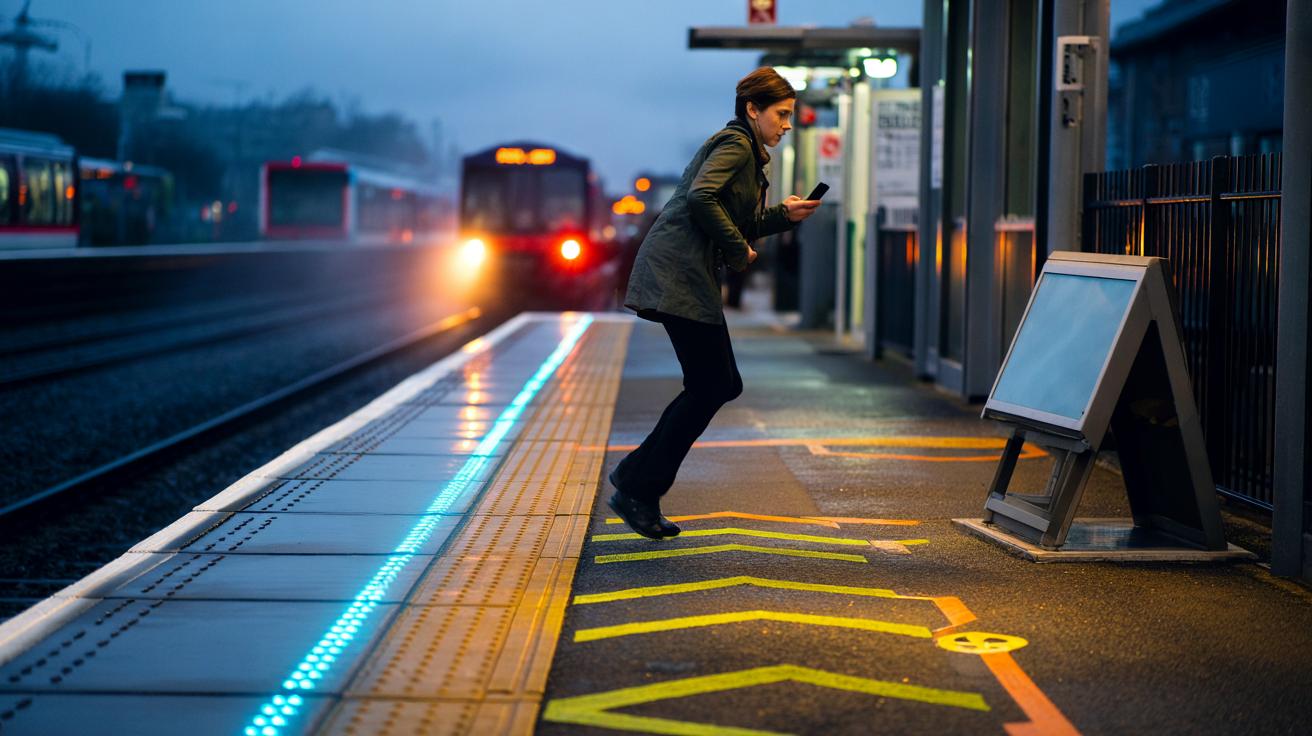
Crucially, safety design must respect the human body. Tactile rumble underfoot can warn even when hands are full and eyes are elsewhere. Angled mirrors extend peripheral vision at blind corners. On roads, daylight-visible LEDs embedded in kerbs meet pedestrians at eye-down smartphone height. In warehouses, projected light lanes shift with forklift movement, keeping distance intuitive. The key is choice architecture: curate defaults and make deviations feel awkward. Below is a quick snapshot of interventions and the speed at which they typically change behaviour.
| Stimulus | Target Behaviour | Typical Latency to Effect |
|---|---|---|
| High-contrast floor edge | Pause before drop/step | Under 1 second |
| Auditory “ping” + arrow light | Redirect gaze to hazard | 200–500 ms |
| Tactile rumble strip | Slow approach speed | Immediate-on-contact |
| LED kerb at crossings | Heads-up before stepping | Under 2 seconds |
| One-touch deadman switch | Stop machine safely | Instantaneous |
Micro-Interventions in High-Stakes Settings
Consider hospitals. Fatigue and alarms are constant. A colour-coded tray system—red for look-alike, sound-alike drugs; green for routine meds—cuts search time and errors. Pair it with a no-interruption zone marked by floor lighting around the medication trolley. The nurse’s attention is shielded, just long enough to complete a high-risk task. In theatres, a brief, rising tone before a surgical count pulls the team’s gaze to the checklist, synchronising action without shouts.
On rail platforms, staggered tactile paving and bold chevrons focus passenger flow away from train edges. Motion-triggered beacons at the first and last carriage doors shift crowds along the platform, smoothing boarding and reducing shove points. In construction, a simple change—painted “stop frames” at ladder bases—primes three-point contact. Over highways, asynchronous pulsing lights, not steady bars, capture peripheral attention without dazzling drivers, prompting earlier braking. Homes benefit too: illuminated induction hobs that dim unless a pan is present leverage negative feedback to prevent burns. Each fix is small. The cumulative effect is big: habit reshaped at the instant of risk.
Measuring Impact, Ethics, and Cost
Good intentions aren’t evidence. Start with baselines: near-miss logs, CCTV heat maps, dwell-time at hazards. After an intervention, track changes in gaze direction (via spot audits), speed profiles, and incident frequency. A 20% shift in head-turns toward oncoming forklifts might arrive within days; injury reductions usually follow over months. Blend quantitative data with worker feedback to catch unintended consequences like glare or alarm fatigue. If a cue irritates, people will learn to ignore it.
Ethics matter. Not every nudge is neutral. Ensure transparency—signpost why lights or sounds were added—and offer opt-outs where feasible. Align with HSE guidance on proportionality: interventions should reduce risk without stigmatising users or creating accessibility barriers. Costs are modest compared with downtime and claims, but plan lifecycle maintenance. LEDs fail. Paint fades. Habits drift. Build in review cycles and sunset dates for trials. The golden rule holds across sectors: design for real humans, in real noise, with real time pressure, and test whether the cue still cuts through on a rainy Tuesday at 5 a.m.
Attention is precious. It is also steerable. By elevating salient cues, trimming friction, and timing prompts to the “hot seconds” before error, organisations can divert danger fast and fairly. The trick is to be specific, humble, and empirical—change one thing, observe, iterate, keep what works. Safety thrives when the right action feels obvious, effortless, and immediate. Looking at your workplace, street, or home, which single cue—light, colour, sound, texture—would most quickly turn a near-miss into a non-event this week?
Did you like it?4.3/5 (27)